Active Vibration Isolators: Features, Weaknesses and Limitations
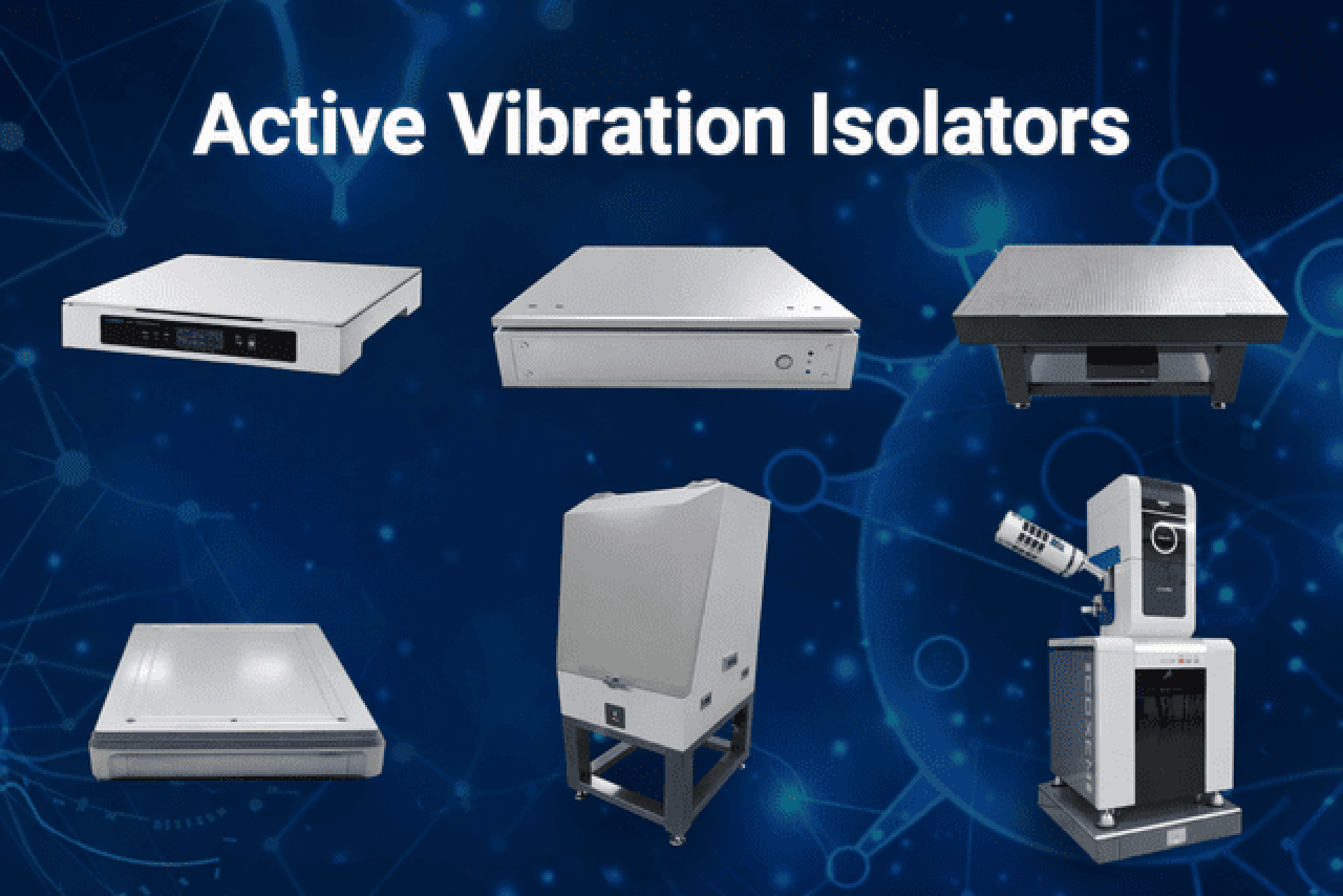
Active Vibration Isolators are vibration prevention systems that use control through sensors and actuators working with feedback control loops to adjust the support force of the isolation platform in real-time. The general principle involves installing motion or acceleration sensors on the platform, which then send signals to actuators such as magnetic motors to generate anti-vibration forces in the opposite direction to the occurring vibrations. This helps the isolation platform better suppress vibrations from the floor or machine to the platform, especially at low frequencies and resonance frequencies where passive systems perform less effectively.
Control Technologies in Active Vibration Isolators
Active vibration isolators use various control algorithms to achieve more effective vibration reduction. Common control methods include:
PID Control: A classic control method using proportional error (P), integral sum (I), and derivative response (D) to adjust the opposing force, effectively reducing vibrations in systems with linear assumptions.
Adaptive Control: The controller automatically adjusts itself according to system or environmental changes, such as finding optimal parameters when the platform load changes.
Fuzzy Logic Control: Uses rule-based methods instead of exact mathematical functions, suitable for systems with high uncertainty or nonlinearity, effectively handling model uncertainties.
Robust Control / Optimal Control: Advanced algorithms such as H-infinity, LQG, or Model Predictive Control (MPC), used when systems have uncertainties or multi-input multi-output problems. Design typically emphasizes robustness against errors and external disturbances.
Artificial Intelligence and Neural Networks: Learn complex system relationships from data and can approximate control offline or online to handle complex nonlinearities.
Other Modern Techniques: Such as feedforward compensation and model inversion techniques to compensate for actuator inertia or hysteresis. Some research uses Particle Swarm Optimization or AI methods to more accurately adjust control parameters.
Comparing Active and Passive Isolators
When comparing Active Vibration Isolators with Passive Vibration Isolators, passive systems have simple structures, easy installation, low costs, and require no external power. However, their performance is limited to high to medium frequency ranges only. Low-frequency vibrations or those near resonance frequencies receive limited attenuation and may even experience signal amplification, causing increased platform vibrations.
Active systems have the advantage of effectively reducing vibrations in low-frequency ranges due to continuous feedback from sensors and actuators adjusting support forces. This makes active systems suitable for high-precision applications, capable of real-time balancing and maintaining vibration isolation performance over wider frequency ranges. However, active vibration isolators require external power sources, are more complex to use, and have higher costs.
Strengths, Weaknesses, and Limitations of Active Vibration Isolators
Strengths
Can create wideband vibration isolation systems, especially at low frequencies, minimizing impact on precision instruments. Fast response, significantly improving equipment performance under changing vibration conditions. Additionally, feedback control capability provides high-precision vibration reduction and flexibility for various operating conditions.
Weaknesses
Require multiple sensors and actuators, have high costs, and need electrical power for operation. Also feature mechanical and control software complexity, requiring careful design to prevent errors. The system needs sufficient actuator drive power to support the initial system weight. Therefore, using highly stiff actuators may reduce bandwidth and vibration cancellation efficiency.
Limitations
Actuators typically have limited stroke, making them unsuitable for very large vibrations. Multi-DOF systems (such as 6-axis) require multiple actuators working together, causing cross-coupling problems between axes and requiring decoupling techniques. Additionally, feedback control may experience latency or sensor noise, requiring design for stability and robustness against abnormal conditions.

Application Examples of Active Vibration Isolators
- High-Precision Machinery: Such as large telescopes, particle accelerator systems, high-precision interferometers, or lithography machines in the semiconductor industry, including nano-level measurement instruments (such as Atomic Force Microscopes) requiring foundation stability.
Research Laboratories and Nanotechnology: Electron microscopy equipment (SEM/TEM), wafer inspection machines, nano-imprint machines, or experiments using instruments highly responsive to vibrations. Installing active isolators can help make experimental results more accurate.
Semiconductor and Electronics Industries: Such as advanced lithography machines in electronics component manufacturing plants requiring the most precise positioning and placement. Active vibration isolation systems reduce vibrations contaminating from other machines or factory floors, increasing production rates and reducing errors.
Space and Aviation Technologies: Platforms for installing measurement devices or payloads on satellites and spacecraft, which must withstand small micro-vibrations from rotation or internal mechanical parts. Recent research has applied Stewart platforms with piezoelectric actuators to create vibration isolation systems for satellites to maintain sensor accuracy.
Because Active Vibration Isolators are critical instruments for both laboratories and advanced micro- and nano-scale industries, Hong Kong NTI provides services and distributes high-performance instruments from leading global brands.
With over 16 years of international expertise, we have delivered advanced instruments and professional services to support efficient research and development.
Contact us:
725 S-Metro Building, 20th Floor, Sukhumvit Road,
Khlong Tan Nuea, Watthana, Bangkok, Thailand
Tel: +66 2-821-5278
Email: info@hknti.com
LINE: https://line.me/R/ti/p/@816txpya