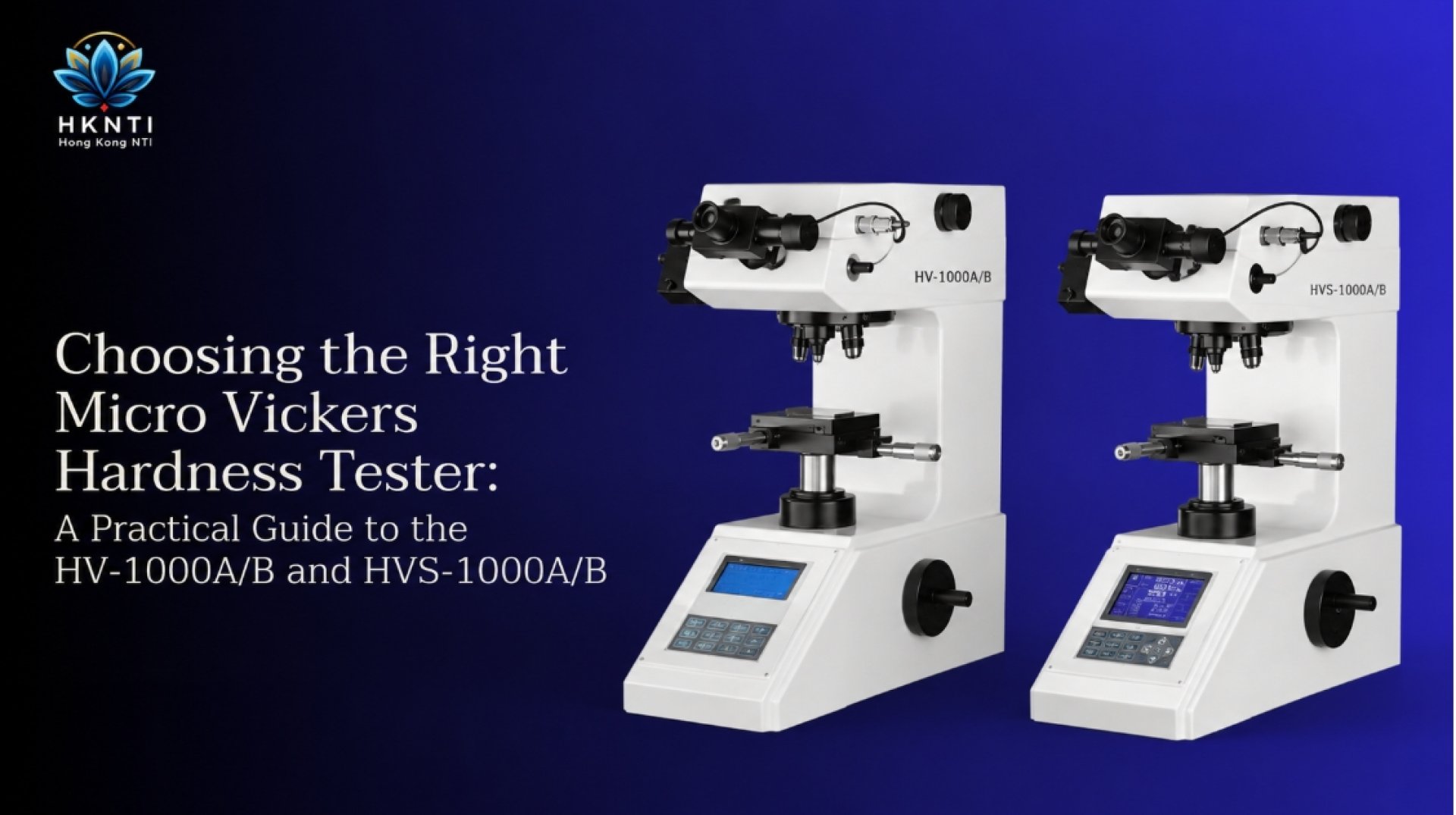
Choosing the Right Micro Vickers Hardness Tester: A Practical Guide to the HV-1000A/B and HVS-1000A/B
HKNTI Instrumentation & Metrology Engineering · June 10, 2026
Micro Vickers hardness measurement is a critical capability in materials science and quality control, enabling precise evaluation of mechanical properties in specimens that are too small, thin, or geometrically constrained for conventional hardness methods. This technical review, prepared by the Technical Documentation Division of HKNTI, isolates and examines four seminal models: the HV-1000A, HV-1000B, HVS-1000A, and HVS-1000B.
All four instruments operate over a shared, consistent metrology core, with a measuring range of 1–3065 HV across eight selectable test forces (10–1000 gf). Compliance with international standards is absolute; every measurement carries the dual-verification authority of GB/T 4340.2 (Chinese national machine verification), ISO 6507-2 (international machine calibration), and ASTM E384 (American standard for microindentation testing).
However, beyond fundamental metrology accuracy, the A/B platform addresses the pivotal operational decisions that recur in every test cycle: How does the operator switch between observation and indention? How is the result recorded and managed? By offering structured choices between automatic versus manual turret configurations, and digital connectivity versus local streamlined interfaces, laboratories can deploy the configuration whose operating rhythm precisely matches their actual daily testing demands.
What Each Model Offers at a Glance
The four models share a common mechanical chassis (470 x 320 x 500 mm, ~40 kg), power supply (AC 220 V), frictionless spindle for load consistency, coordinate test anvil, and dual optical magnification (400× measurement / 100× observation).
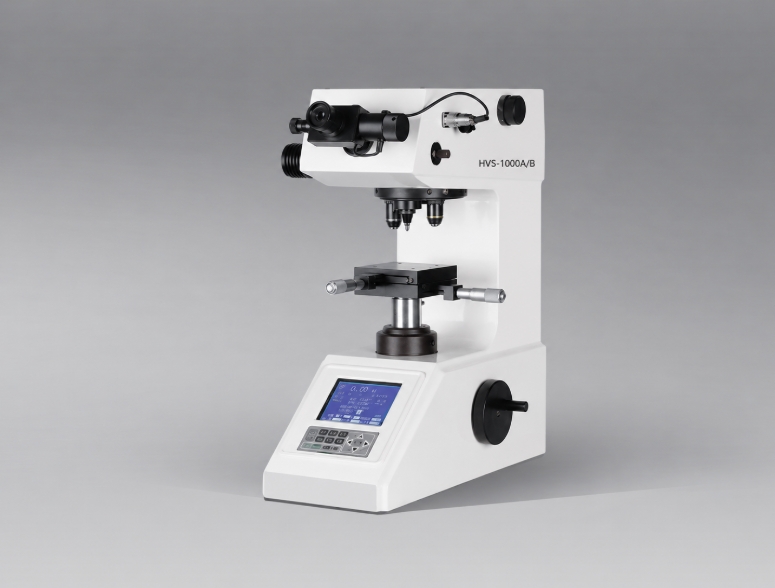
HVS-1000A (Digital Display · Automatic Turret)
- Defining Feature: Motorized auto-turret, making the full test cycle automatic and eliminating operator effort in turret switching.
- Interface & Data: Digital display with multi-scale conversion and a 0.0625 µm finer detection resolution. Features integrated RS232 output for lab integration.
HVS-1000B (Digital Display · Manual Turret)
- Defining Feature: Manual turret rotation, offering the operator direct physical feel and control over positioning during multi-step measurement tasks.
- Interface & Data: Retains the high-resolution digital display (0.0625 µm), multi-scale conversion, and integrated RS232 output of the HVS-1000 line.
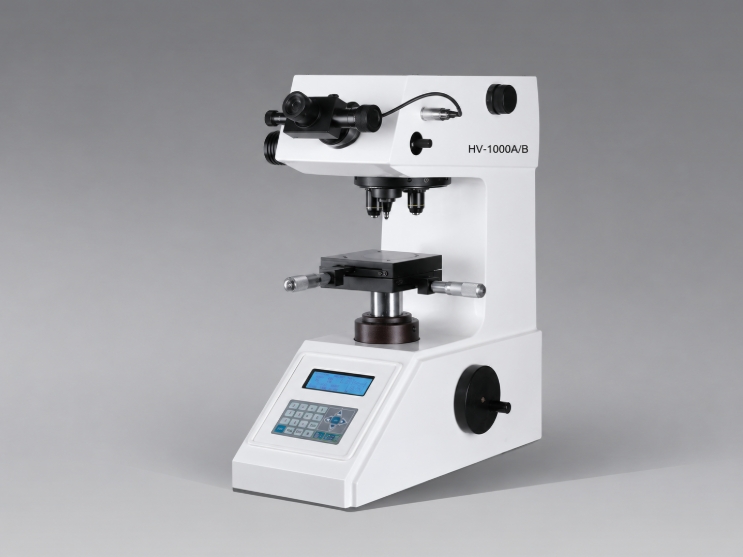
HV-1000A (Micro Vickers · Automatic Turret)
- Defining Feature: A streamlined alternative prioritizing a faster operational cycle and less operator fatigue.
- Interface & Data: Features the motorized auto-turret for a fully automated test sequence. Utilizes a standardized Micro Vickers display interface with a 0.25 µm detection resolution (finer resolution and data output are omitted for reduced interface complexity).
HV-1000B (Micro Vickers · Manual Turret)
- Defining Feature: The base operational platform, offering identical metrology at the most reduced interface complexity and mechanism cost.
- Interface & Data: Manual turret rotation and standardized display (0.25 µm detection), fully adequate for general-purpose hardness verification where external data management is not prioritized.
Technical Parameter Differentiators
This table isolates the critical parameters that distinguish the four configurations, illustrating where the choices diverge for measurement resolution, data connectivity, and mechanization.
| Parameter | HVS-1000A | HVS-1000B | HV-1000A | HV-1000B |
| Measuring Range | multicolumn{4}{c | }{1 – 3065 HV} | ||
| Test Forces (N) | multicolumn{4}{c | }{0.09807, 0.2452, 0.4904, 0.9807, 1.961, 2.942, 4.904, 9.807} | ||
| Test Forces (gf) | multicolumn{4}{c | }{10, 25, 50, 100, 200, 300, 500, 1000} | ||
| Hardness Scales | multicolumn{4}{c | }{HV0.01, HV0.025, HV0.05, HV0.1, HV0.2, HV0.3, HV0.5, HV1} | ||
| Turret Configuration | Automatic (Motorized) | Manual | Automatic (Motorized) | Manual |
| Min. Detection Unit | 0.0625 µm (Finer) | 0.0625 µm (Finer) | 0.25 µm | 0.25 µm |
| Data Connectivity | RS232 (Integrated) | RS232 (Integrated) | — | — |
| Hardness Conversion | Yes (Multi-scale on-instrument) | Yes (Multi-scale on-instrument) | — | — |
| Optical Magnification | multicolumn{4}{c | }{400× measurement / 100× observation} | ||
| Max. Sample Height | multicolumn{4}{c | }{75 mm} | ||
| Overall Dimensions | multicolumn{4}{c | }{470 × 320 × 500 mm / approx. 40 kg} | ||
| Power Supply | multicolumn{4}{c | }{AC 220 V · 50/60 Hz} |
Dynamic Impact: How Turret and Interface Decisions Define Your Workflow
The right Micro Vickers hardness tester is not always the one with the highest theoretical capability; it is the one whose operating rhythm matches the environment it will support day-to-day. The choice of turret and data interface determines whether that environment is high-throughput inspection or investigator-driven research.
Automated Turrets: Eradicating Variation in High-Volume Settings
On the HV-1000A and HVS-1000A, the motorized turret rotation eliminates the operator’s physical involvement in turret switching entirely. The complete sequence—locate, indent, measure—is automated via software control. Across repetitive quality control inspections where hundreds of measurements are performed daily, this eradicates operator fatigue as a variable, reduces cumulative test cycle time, and ensures a more consistent load application rate for highly repeatable results.
Manual Turrets: Responsiveness in Variable Research Tasks
In a R&D or advanced metallurgy environment where operators must make investigative decisions between measurements—adjusting force, Consult technical standards, or altering sample orientation—the immediate tactile feedback and physical control of the manual turret on the B variants can offer greater flexibility and responsiveness without compromising the shared metrology core.
The HVS Data Pathway: Removing Transcription and Standardizing Data
The RS232 interface on the HVS-1000A and HVS-1000B represents a critical strategic decision for any facility where test records must travel. This connectivity eliminates the manual transcription of results, which is a routine source of recording error. For data integration into LIMS, spreadsheets, or automated quality documentation, the HVS line is indicated.
Furthermore, the 0.0625 µm detection resolution—finer than the 0.25 µm resolution of the HV line—matters when analyzing shallow coatings, thin-film layers, or case depth gradients near transition points where small indentation diagonal differences carry diagnostic significance.
Advanced Capability and Universal Compliance
The full range of Micro Vickers materials and specimen types is covered by the shared metrology performance of all four models: Ferrous and non-ferrous alloys, IC substrates and semiconductor wafers, surface coatings, glass and ceramics, carburized and nitrided case layers, thin sheet metal, micro-scale parts, and diffusion gradients.
Every configuration ships with a complete accessory suite including: diamond pyramid indenter, coordinate test anvil, specialized anvils (thin-shaft, thin-plate, flat jaw vice, large/small V-shaped blocks), and standard microhardness reference blocks. The HVS-1000A/B additionally includes an integrated mini thermal printer for hardcopy output.
Importantly, the metrology authority for all four models remains identical;compliance with GB/T 4340.2, ISO 6507-2, and ASTM E384 is universal. The turret and data interface decisions are made once at procurement, but the precision measurement performance they share is available across every configuration.