From Measurement to Insight: How the HYHVS-1000ZT2.1 and ZT3.1 Automate the Entire Hardness Testing Workflow
HKNTI Instrumentation & Metrology Engineering · Technical Documentation Division ·
June 10, 2026
Conventional micro Vickers hardness testing typically answers one question at a time: how
hard is this spot? For modern quality inspection and materials research, however, the
meaningful questions are increasingly complex: how does hardness vary across a
cross-section? How deep is the effective case hardening? How consistent is a carburized
layer across a batch of parts?
Answering these questions accurately with a standalone hardness tester has traditionally
required repetitive manual positioning, individual measurements, and laborious post-hoc
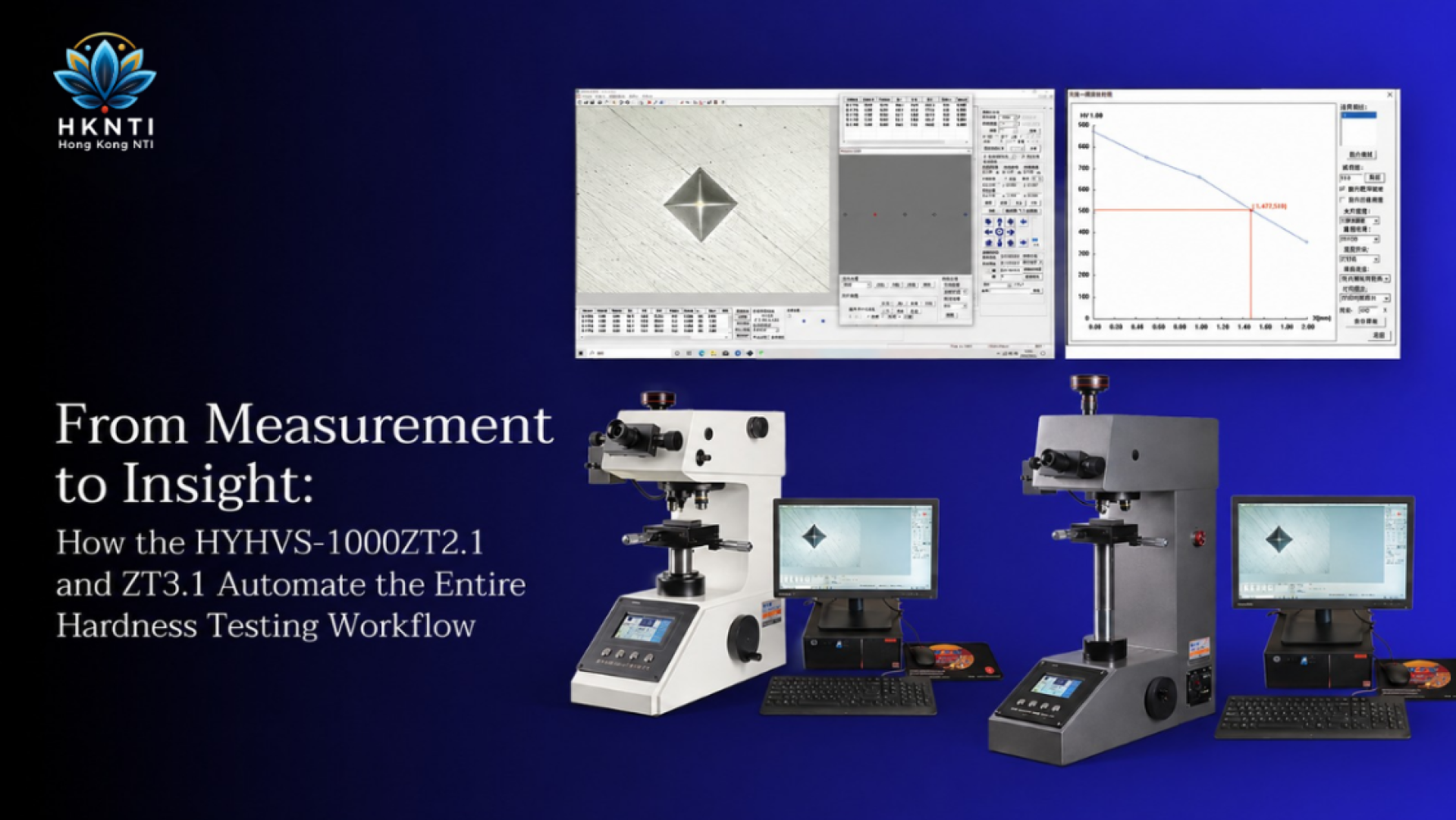
data assembly. The HYHVS-1000ZT2.1 and HYHVS-1000ZT3.1 integrated platforms from
HKNTI are designed specifically to replace that manual workflow.
These instruments are not merely faster point-measurement devices; they are closed-loop
analysis systems that unify electrical control, optical imaging, mechanical displacement, and
computer processing. By placing the hardness tester host (featuring a 5.6-inch LCD touch
screen), a motorized coordinate stage, a 3-megapixel digital camera, and the HYHV300T
image measurement system under unified computer control, these platforms output
automated traverses, real-time curves, and formatted case depth reports directly from a
single operator command.
Two Tiers of Automation: ZT2.1 vs. ZT3.1
Both models share an identical, robust metrology foundation (1–3065 HV range, eight test
forces from 10 to 1000 gf, dual 400×/100× magnification, and 0.0625 µm minimum
detection), differing primarily in their degree of automated execution.
HYHVS-1000ZT2.1 (Semi-Automatic)
- Degree of Automation: Semi-automatic. The operator defines the measurement
sequence, positions the stage, and initiates each measurement via computer or
joystick. - Key Components: ARM high-speed processor, motorized coordinate stage
(supporting computer, manual, and joystick control), integrated HYHV300T2.1 image
measurement system, and 3-megapixel digital camera. - Capabilities: Semi-automatic measurement, one-click effective hardened layer depth
analysis, error correction/calibration, and database query/management.
HYHVS-1000ZT3.1 (Fully Automatic)
- Degree of Automation: Fully automatic. Once a traverse path is defined, the entire
sequence executes without human intervention. - Key Components: All ZT2.1 components, but upgraded with the HYHV300T3.1
image system and a motorized lifting screw rod for auto-focus capability. - Capabilities: Automated turret rotation, auto-focus, auto-load, auto-displace,
auto-read, one-click effective hardened layer depth analysis, and database
management.
Technical Parameter Specifications
This table isolates the critical parameters that distinguish the two tiers of automation within
the ZT platform's shared high-resolution architecture.
| Parameter | HYHVS-1000ZT2.1 | HYHVS-1000ZT3.1 |
| Measuring Range | multicolumn{2}{c | }{1 – 3065 HV} |
| Test Forces (N) | multicolumn{2}{c | }{0.09807, 0.2452, 0.4904, 0.9807, 1.961, 2.942, 4.904, 9.807} |
| Test Forces (gf) | multicolumn{2}{c | }{10, 25, 50, 100, 200, 300, 500, 1000} |
| Hardness Scales | multicolumn{2}{c | }{HV0.01 · HV0.025 · HV0.05 · HV0.1 · HV0.2 · HV0.3 · HV0.5 · HV1} |
| Automation Level | Semi-automatic | Fully automatic |
| Auto Focus | — | Yes (motorized lifting screw) |
| Stage Control | Computer, manual, joystick |
Computer, manual, joystick |
| Optical Magnification |
multicolumn{2}{c | }{400× measurement / 100× observation} |
| Min. Detection Unit |
multicolumn{2}{c | }{0.0625 µm (Finer)} |
| Image System | HYHV300T2.1 | HYHV300T3.1 (Auto-Focus) |
| Digital Camera | multicolumn{2}{c | }{3-megapixel} |
| Case Depth Analysis |
multicolumn{2}{c | }{One-click automatic (curve generation + report)} |
| Throat Depth | multicolumn{2}{c | }{110 mm} |
| Max. Sample Height |
multicolumn{2}{c | }{75 mm} |
| Overall Dimensions |
multicolumn{2}{c | }{470 × 320 × 500 mm / approx. 40 kg} |
| Power Supply | multicolumn{2}{c | }{AC 220 V · 50/60 Hz} |
Dynamic Functionality: How the Integrated System
Directs Workflow
The ZT platform doesn't just digitize traditional methods; it dynamically reconfigures the
workflow by uniting electrical control, optical imaging, and automated processing into a
unified workstation.
Step-by-Step Integrated Execution1. Unified Computer Control: The HYHV300T system places all instrument actions
1. under computer supervision. The operator interacts with a single software interfacefor stage positioning, turret rotation, test force selection, focus, data capture, and
report output—eliminating the need to interface with multiple control panels or
separate workstations.
2. Subjectivity-Free Imaging and Measurement: Diagonal estimation is handled by
on-screen measurement using the 3-megapixel digital camera. This eliminates the
inter-operator variability inherent in manual optical filar eyepieces. For low test
forces, where small indentations are susceptible to measurement error, this digital
precision locked down programmatically is critical.
3. Real-Time Microstructural Correlation: The system enables the precise location of
each indentation to be marked in real time on the captured metallographic image.
This supports direct visual correlation between hardness data and microstructural
transitions (e.g., carburized layer boundaries, weld heat-affected zones, or gradient
profiling across diffusion zones).
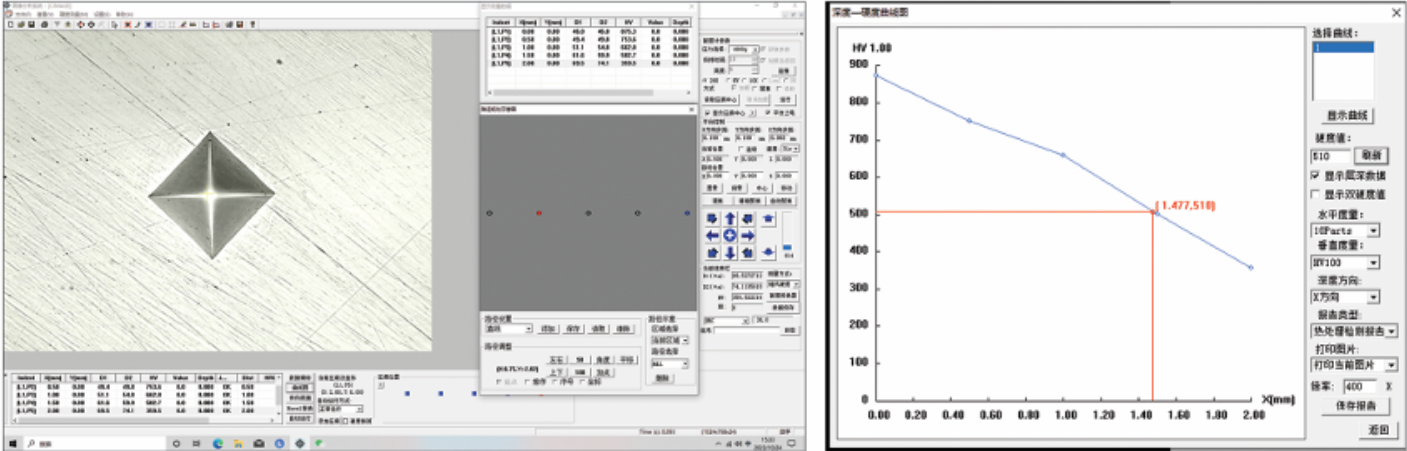
capability is its integrated effective hardened layer depth measurement.
Following a programmed traverse, the system automatically calculates the
curve, determines effective case depth at a specified threshold, and generates a
formatted report—completing what would otherwise require individual
measurement, manual re-entry, and spreadsheet assembly in a single
automated command.
hardness measurement is an input to a larger analytical process: Ferrous and non-ferrous
alloy research, gradient hardness profiling, thin-specimen characterization, IC
substrates/semiconductors, brittle materials (glass, ceramics), weld HAZ traverses, and
effective case depth documentation.
coordinate test platform, joystick control, digital camera, brand computer, measurement
software (dongle), specialized data cable, and multiple test anvils (thin-shaft, thin-plate,
V-shaped, flat jaw vice). Fundamental accuracy is universal; compliance with GB/T 4340.2,
ISO 6507-2, and ASTM E384 is total across every configuration.
determined in the moment or defined in advance.
- If your primary workflow involves repeated, programmed hardness traverses, batch
documentation, or standardized case depth verification, the ZT3.1’s fully automatic
operation—executing every step including auto-focus without interruption—is
indicated for high analytical throughput and labor reduction. - If your laboratory’s work is highly varied—a mix of ad hoc measurements, variable
exploratory traverses, and point hardness checks where the operator must actively
make decisions between steps—the ZT2.1 provides the same imaging quality and
analysis with greater responsiveness in stage navigation.
Both configurations represent a substantive capability leap within materials characterization,
replacing the assembly of raw measurement data with an integrated analysis platform.