Comprehensive Hardness Testing Systems: A Technical Review of the 420HRS-150Z and 420HRSS-150Z
Rockwell hardness testing remains one of the most widely adopted methods for the mechanical characterization of metallic and non-metallic materials, owing to its exceptional speed, repeatability, and minimal specimen preparation requirements.
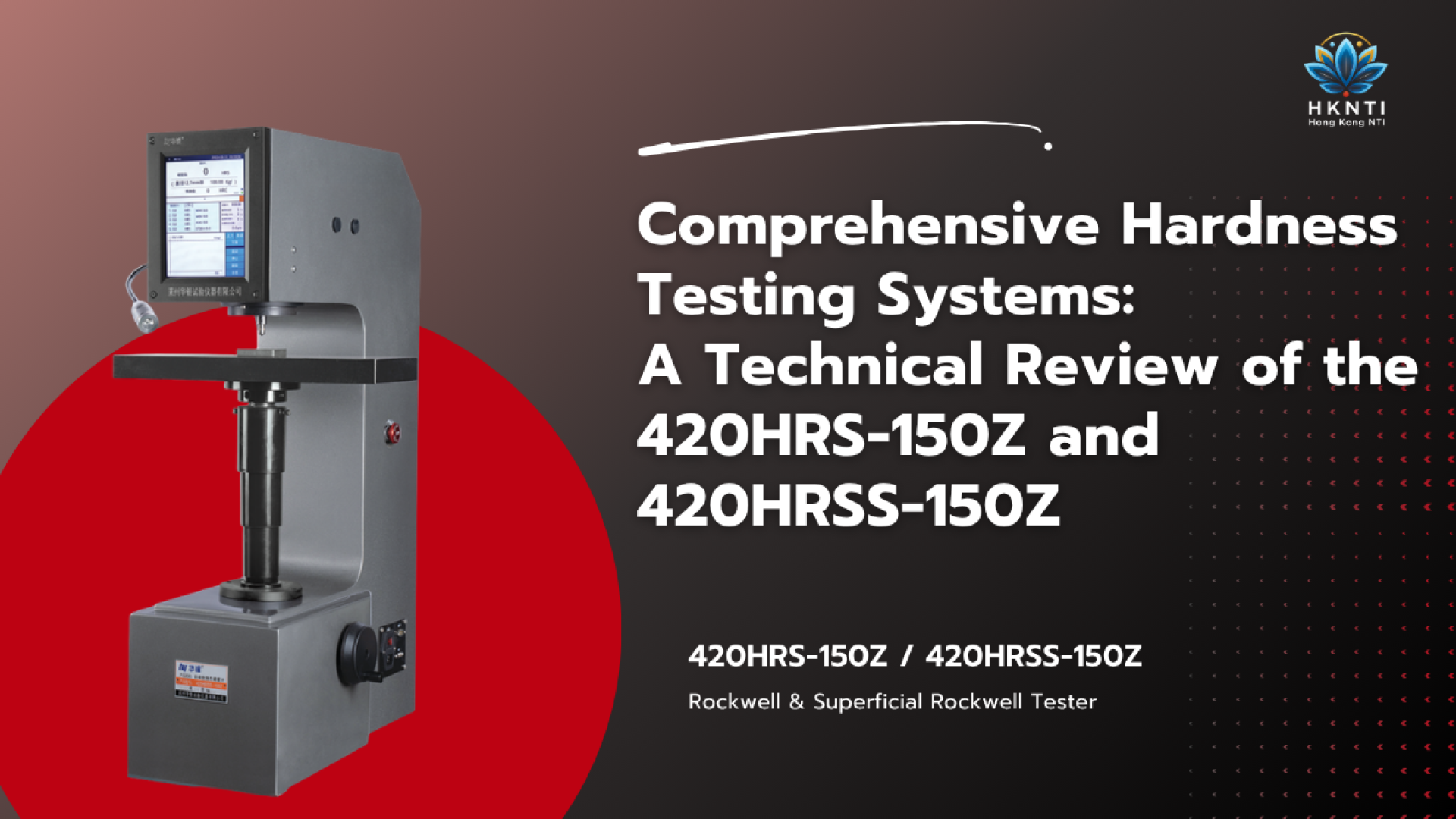
This technical overview evaluates the 420HRS-150Z and 420HRSS-150Z automatic hardness testers. Engineered to eliminate operator-dependent errors, these instruments integrate closed-loop force control and a fully automated indentation cycle to deliver high-precision measurements across conventional and superficial scales.
️System Architecture & Process Automation
Moving away from traditional mechanical dead-weight lever systems, these instruments feature a fully electronically controlled platform built around three coordinated subsystems:
- Closed-Loop Force Control: Utilizing an internal sensor, the system continuously monitors and corrects the applied load during the loading, dwelling, and unloading phases. It also features automatic surface convexity compensation, eliminating systematic errors when testing curved parts.
- One-Key Automated Cycle: With a single button press, the Z-axis automatically lifts, brings the specimen into contact with the indenter, applies/holds/releases the force, and returns. This guarantees completely operator-independent repeatability. A real-time Displacement–Force curve is displayed during indentation.
- Intelligent UI: An 8-inch LCD touchscreen handles all parameter configurations (scale, dwell time, indenter selection). It supports bilingual operation (Chinese/English), automatic scale conversion, and upper/lower limit tolerance alarms for quick pass/fail quality control.
Capabilities Comparison: 420HRS-150Z vs. 420HRSS-150Z
The core differentiator between the two configurations lies in their scale coverage and target application environments:
| Technical Specification | 420HRS-150Z (Regular Rockwell) | 420HRSS-150Z (Twin/Combined System) |
| Total Scales Supported | 15 Scales | 30 Scales (Regular + Superficial) |
| Regular Rockwell Scales | HRA, HRBW, HRC, HRD, HREW, HRFW, HRGW, HRHW, HRKW, HRL, HRM, HRP, HRR, HRS, HRV | Fully supported (Identical to 420HRS-150Z) |
| Superficial Scales | Not Supported | 15 Additional Scales (15N/30N/45N, 15T/30T/45T, 15X/30X/45X, 15Y/30Y/45Y, 15W/30W/45W) |
| Applied Test Forces | 588.4 N, 980.7 N, 1471 N | Adds low-force capabilities: 147.1 N, 294.2 N, 441.3 N |
| Primary Target | Bulk materials, thicker metal stock | Thin coatings, sheet metals, surface-treated layers |
Engineering Insight: The Superficial Rockwell capability of the 420HRSS-150Z is critical for surface engineering. By using lighter test forces, it prevents the indenter from punching through a thin hardened case into the softer underlying substrate, ensuring accurate measurement of the surface layer alone.
Scope of Application
1.Regular Rockwell Testing (Both Models)
- Soft ferrous and non-ferrous metals.
- High-hardness alloys such as cemented carbide.
- Heat-treated parts (quenched and tempered components).
- Select non-metals including industrial plastics and bakelite.
2.Superficial Rockwell Testing (420HRSS-150Z Only)
- Thin sheet metal or metal parts requiring shallow indentation.
- Surface-treated layers following carburizing, nitriding, or electroplating.
- Precision components where minimizing visible indentation marks is required.
- Delicate industrial non-metals like specialized composites and dense cardboard.
Global Compliance & Data Management
Measurement accuracy strictly complies with the three major international standards governing Rockwell calibration and traceability:
- ISO 6508-2 (International)
- ASTM E18 (American)
- GB/T 230.2 (Chinese)
Data Connectivity and Smart Factory Integration:
Equipped with both USB and RS232 interfaces, alongside a built-in thermal micro-printer, the systems allow direct database storage and synchronized test data exporting. An optional upper-computer host system can be integrated for centralized data management and intelligent automated process control.
Standard Accessories Pack
To allow immediate laboratory deployment, both systems are shipped with a premium accessory kit:
- Anvils: Large flat, small flat, and V-type anvils to accommodate varied sample geometries.
- Indenters: A diamond cone (Brale-type) indenter and a 1.588 mm tungsten carbide ball indenter.
- Reference Blocks: 5 standard Rockwell hardness blocks (The 420HRSS-150Z includes 4 additional Superficial Rockwell blocks for extended scale verification).
Conclusion
The 420HRS-150Z and 420HRSS-150Z exemplify the modern laboratory shift toward closed-loop, software-driven metrology. For facilities exclusively testing bulk materials, the 420HRS-150Z offers a highly cost-efficient and robust solution. However, for operations dealing with thin layers, surface hardening treatments, or advanced surface engineering, the expanded scale set of the 420HRSS-150Z represents an indispensable multi-purpose investment.